Official product information
How TheyaVue Works, and What AREDS2 Actually Found
What lutein and zeaxanthin do in the macula, what AREDS2 tested and in whom, and how this label compares to it row by row.
Written and reviewed by the TheyaVue Editorial Desk · Last updated September 23, 2026
Quick answer
Lutein and zeaxanthin concentrate in the macula and are the reason this category exists. The National Eye Institute tested them at 10 mg and 2 mg in AREDS2 — in people who already had macular degeneration. At the directed two capsules only copper matches AREDS2, and NEI states the supplements “do not prevent AMD onset”.
Mechanism
What lutein and zeaxanthin actually do
A real piece of eye biology, stated plainly before anything is claimed for it.
There is a real mechanism at the centre of this category, and it is worth understanding properly before anything is judged against it. Lutein and zeaxanthin are carotenoids, and unlike most carotenoids they do not simply circulate: they accumulate in the macula, the small central patch of the retina responsible for detailed, central vision. That accumulation is dense enough to be visible as a yellow pigment, which is why the macula is called what it is. The pigment absorbs short-wavelength light and acts as an antioxidant in tissue that is exposed to more light than any other in the body. None of that is contested and none of it is marketing.
Where the argument gets made
The step from that biology to a capsule is the step everything turns on. The body cannot make lutein or zeaxanthin, so all of it comes from diet — principally dark leafy greens — and macular pigment levels can be raised by taking more. The argument a supplement makes is that raising the pigment protects the retina over time. That argument is not invented, and it is exactly what the National Eye Institute set out to test.
The other ingredients, briefly
The rest of the bottle is an antioxidant and micronutrient list rather than a second mechanism. Vitamin C and vitamin E are antioxidants with federal fact sheets. Zinc and copper are the AREDS backbone, copper present specifically because high-dose zinc interferes with copper absorption. Bilberry, eyebright, quercetin, rutin, taurine, grape seed and lycopene are there on general antioxidant and traditional-use arguments. Alpha lipoic acid is the same. None of those has a federal consumer page describing an effect on vision.
The comparison
This label against AREDS2, row by row
Six comparable rows and two that cannot be compared at all.
Lutein and zeaxanthin are the reason this category exists, and unusually for a supplement ingredient they have a specific federal evidence base with published numbers attached: the National Eye Institute’s AREDS2 trial. That makes this the rare label that can be checked against a real formula rather than against a shrug. It does not come out of the comparison well, and the reason is not the one most buyers would guess.
The AREDS2 formula is public and specific: vitamin C 500 mg, vitamin E 400 IU, zinc 80 mg, copper 2 mg, lutein 10 mg, zeaxanthin 2 mg. Here is this label set against it at the directed two capsules a day. The solid bar is this product; the hatched bar behind it is the trial amount. Where the two figures are not in the same unit, or where this label publishes no figure at all, the bar is left empty rather than guessed at.
TheyaVue at the directed two capsules The AREDS2 amount
One row matches. Every other row that can be compared is below the trial amount, and the two rows the whole category is sold on — lutein and zeaxanthin — cannot be compared at all, because their amounts sit inside a proprietary blend. If the entire 240.5 mg blend were lutein it would clear AREDS2’s 10 mg many times over. It is not: it is ten ingredients sharing one number, and the split is not published.
The vitamin E row, and why it has no bar
AREDS2 used 400 IU and this label prints 10 mg a capsule, which is 20 mg at the directed dose. Those are different units and the conversion is not a single fixed number, because it depends on the form. ODS puts it this way: “1 mg vitamin E = 1 mg d-alpha-tocopherol (natural vitamin E) = 2 mg dl-alpha-tocopherol (synthetic vitamin E).” This panel prints DL-alpha tocopherol acetate, the synthetic form, which is the less potent of the two by weight. We could produce a figure by converting, and it would still be our figure rather than the label’s, so the bar stays empty and the note says why.
The beta-carotene row, and why it is not a shortfall
One safety note that belongs on the front of every eye supplement and is on almost none of them. AREDS2 removed beta-carotene from the original AREDS formula, because, in NEI’s words, “AREDS2 participants who were former smokers who took a formulation with beta-carotene had a higher incidence of lung cancer”, and its guidance is that current and former smokers should avoid the beta-carotene formula. This product’s vitamin A is beta-carotene. The amount is small — 50 mcg RAE a capsule, 5% of a day’s value — and the studies behind that warning used high-dose supplements. If you smoke or used to, this is the row to raise with a clinician before you start.
The honest section
Who AREDS2 was run in, and what NEI says it did not do
And here is the part that matters more than any row in that table. AREDS2 was run in people who already had intermediate or advanced age-related macular degeneration. NEI’s own summary of both trials is blunt: the supplements “do not prevent AMD onset”, and they gave no benefit to people without AMD or with early-stage disease. On cataracts the finding is flatter still: “None of the formulations decreased cataract risk.” A healthy-eyed buyer taking this because of a trial they half remember is taking it for a result that trial did not produce in people like them.
The two sentences that matter most
“AREDS and AREDS2 supplements do not prevent AMD onset.” and “None of the formulations decreased cataract risk.” Both are the National Eye Institute’s own summary of its own trials, and between them they rule out the two reasons most people buy an eye supplement.
Who was actually in the trial
This is the part that almost never survives the journey from a trial to a product page, so it is worth stating slowly. AREDS and AREDS2 enrolled people who already had age-related macular degeneration — intermediate disease in one or both eyes, or advanced disease in one eye. The question the trials asked was whether a specific combination of nutrients, at specific amounts, slowed the progression of an existing disease towards vision loss. That is a narrow, useful, answerable question and the answer was a qualified yes for that population. It is not the question a buyer with healthy eyes is asking. NEI states plainly that the supplements gave no benefit to people without AMD or with early-stage disease, and that they do not prevent AMD onset.
What that leaves, honestly
If you already have intermediate or advanced AMD, the relevant conversation is with an ophthalmologist about the actual AREDS2 formula at the actual AREDS2 amounts, which this product is not and does not claim to be. If your eyes are healthy, the trial this whole category leans on did not study you, and no trial of this particular formula has been published anywhere we could find. What is left is a daily antioxidant and micronutrient capsule containing two macular carotenoids at amounts the label does not publish. That is a fair description, it is not nothing, and it is a great deal less than the page this product is sold from implies.
And the thing that is not in any bottle
NEI’s central instruction costs nothing and outranks everything on this page: “A dilated eye exam is the only way to check for many eye diseases early on, when they’re easier to treat.” If something about your sight has changed — blurring, floaters, night vision, a gap in your field of view — that sentence is the answer, and a capsule is not.
From the listing
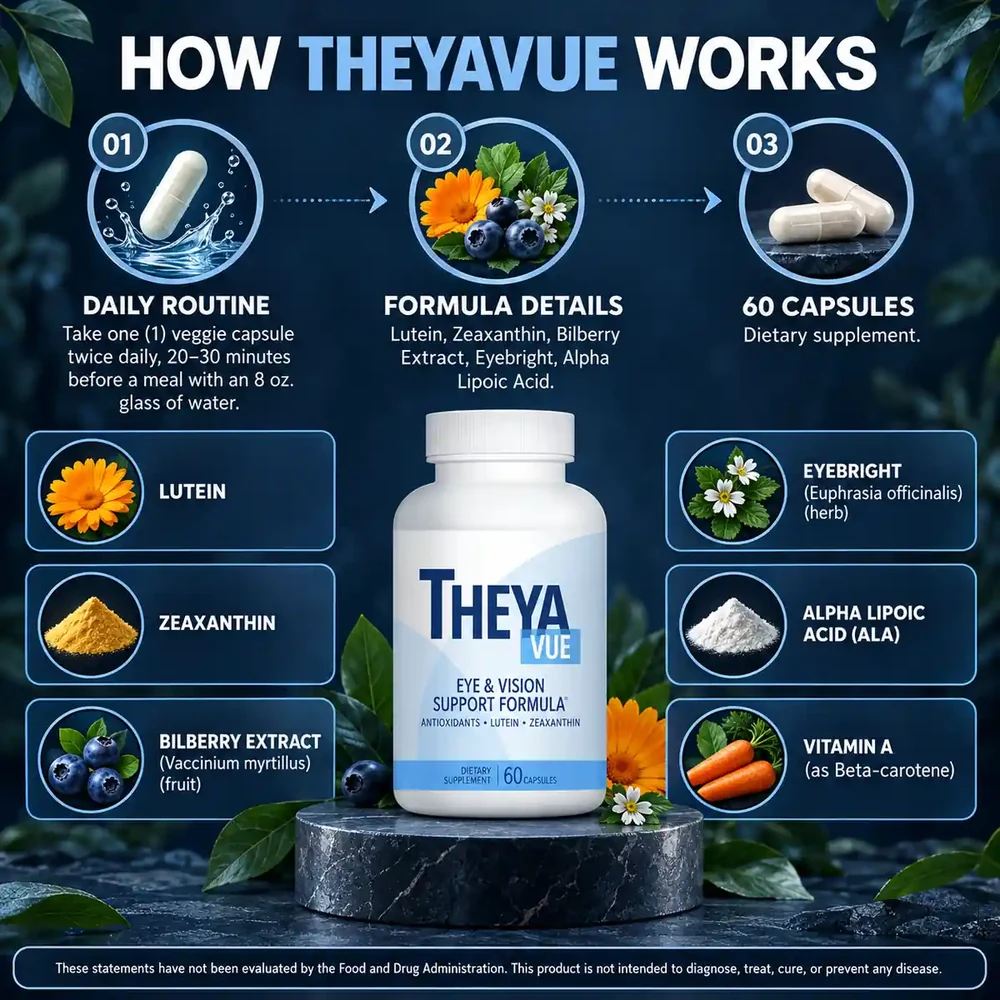
The seller’s own three steps, reproduced
What they describe is a routine, not a mechanism — and that is to their credit.
01 Daily Routine
One veggie capsule twice daily, 20–30 minutes before a meal with an 8 oz. glass of water
02 Formula Details
Lutein, zeaxanthin, bilberry extract, eyebright, alpha lipoic acid
03 60 Capsules
Dietary supplement
That is the seller’s own three-step panel, reproduced word for word. Read what it does and does not say. Step one is a routine. Step two is a list of five ingredient names. Step three is a count and a category. At no point does it claim that a particular ingredient produces a particular effect on a particular timescale, which makes it a more careful piece of writing than the headline on the page the order button leads to.
Taken literally it is also reasonable advice, and the one variable you actually control is in step one. Two capsules a day, at the same two times, before food, with a full glass of water, is a habit rather than a treatment, and consistency is the only thing about this product a buyer can get right or wrong. Everything else — how much lutein is in the capsule, whether that amount does anything, how it compares to a trial formula — was decided before the bottle was filled and is not published.
So the honest version of “how it works” for this product runs like this. The mechanism is real. The trial that tested it is real, and it tested different amounts in people with a disease you may not have. One row of this formula matches that trial. The two rows that matter most cannot be checked. And the single most effective thing you can do for your eyes this year is free, published by the National Eye Institute, and involves an appointment rather than a bottle.
Questions
TheyaVue FAQ: how it works questions
How does it compare to the AREDS2 formula?
Four ingredients overlap. At the directed two capsules a day: copper matches at 2 mg, vitamin C is 200 mg against 500, vitamin E is 20 mg against 400 IU, zinc is 32 mg against 80. Lutein and zeaxanthin cannot be compared at all.
Will TheyaVue improve my eyesight?
Nothing we were given supports that. The label claims support, not improvement, and no trial of this formula has been published. The National Eye Institute’s AREDS2 trial — the closest real evidence in this category — slowed progression in people who already had intermediate or advanced macular degeneration, and NEI states the supplements “do not prevent AMD onset”.
Does it help with cataracts?
NEI’s finding across all the AREDS formulations is one sentence: “None of the formulations decreased cataract risk.” Cataracts are a diagnosis and a surgical question, not a supplement question.
Does it help with night vision?
Bilberry is the ingredient that claim usually rests on. NCCIH: “Studies of the effects of bilberry on night vision have had conflicting results. Much of the research was of poor quality.” More broadly, “Bilberry has not been clearly shown to be helpful for any health condition.”
Has TheyaVue been tested in a clinical trial?
None was supplied and none is published anywhere we could find. Two of its ingredients were tested at specific amounts in AREDS2 — and those amounts cannot be compared to this label, because they are inside a blend.
Is it normal to feel nothing?
For an eye supplement, feeling nothing is the expected experience. Nothing on this label promises a sensation, and none of the federal evidence describes one. If you are waiting to notice something, you may be waiting on the wrong signal.
Should I use this instead of an eye exam?
No, and this is the answer on this page we would ask you not to skim. NEI: “A dilated eye exam is the only way to check for many eye diseases early on, when they’re easier to treat.” The FDA adds that unapproved products claiming to treat eye conditions “may lead consumers to delay or abandon proven, safe treatments”.
References
Sources for this page
- National Eye Institute, NIH. About the Age-Related Eye Disease Studies (AREDS and AREDS2). www.nei.nih.gov. Accessed September 23, 2026.
- National Eye Institute, NIH. Keep Your Eyes Healthy. www.nei.nih.gov. Accessed September 23, 2026.
- NIH Office of Dietary Supplements. Vitamin E. ods.od.nih.gov. Accessed September 23, 2026.
- NIH Office of Dietary Supplements. Zinc. ods.od.nih.gov. Accessed September 23, 2026.
- National Center for Complementary and Integrative Health. Bilberry. www.nccih.nih.gov. Accessed September 23, 2026.
Next
Keep reading
Order TheyaVue from the official page
Two capsules a day, 60 capsules a bottle, so thirty days a bottle. Copper is the one row that lands on the AREDS2 amount. 60 days from purchase to change your mind. Sales line +1 (315) 724-2018.
Price shown at checkout · 60-day window from purchase · ships from inside the US · sales line +1 (315) 724-2018