Official product information
TheyaVue Supplement Facts, Row by Row
The panel transcribed row by row, what every figure becomes at the directed dose, and the two footnote slips on an otherwise careful label.
Written and reviewed by the TheyaVue Editorial Desk · Last updated September 23, 2026
Quick answer
The TheyaVue panel prints a serving of 1 capsule and 60 servings a bottle, then fourteen nutrients with amounts and %DVs and a 240.5 mg proprietary blend of ten. The directions ask for two capsules a day, so a bottle is 30 days and every percentage on the panel doubles — taking niacin to 40 mg NE against a 35 mg upper limit.
The label
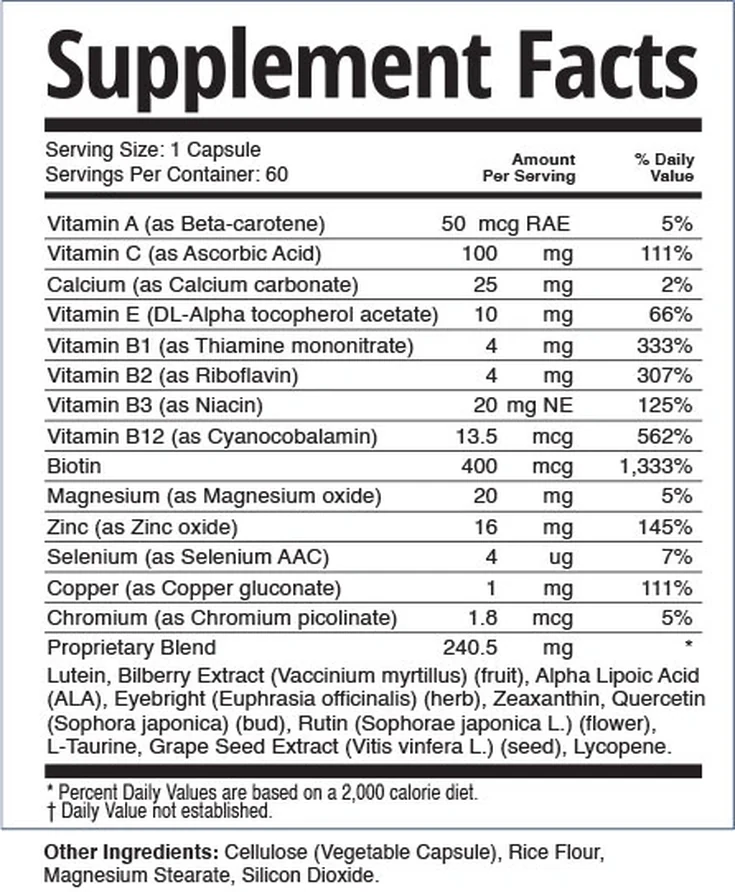
The TheyaVue panel, row by row
Transcribed exactly as printed, including the parts that disagree with each other.
| Panel row | Per serving | %DV |
|---|---|---|
| Serving Size | 1 Capsule | — |
| Servings Per Container | 60 | — |
| Vitamin A (as Beta-carotene) | 50 mcg RAE | 5% |
| Vitamin C (as Ascorbic Acid) | 100 mg | 111% |
| Calcium (as Calcium carbonate) | 25 mg | 2% |
| Vitamin E (DL-Alpha tocopherol acetate) | 10 mg | 66% |
| Vitamin B1 (as Thiamine mononitrate) | 4 mg | 333% |
| Vitamin B2 (as Riboflavin) | 4 mg | 307% |
| Vitamin B3 (as Niacin) | 20 mg NE | 125% |
| Vitamin B12 (as Cyanocobalamin) | 13.5 mcg | 562% |
| Biotin | 400 mcg | 1,333% |
| Magnesium (as Magnesium oxide) | 20 mg | 5% |
| Zinc (as Zinc oxide) | 16 mg | 145% |
| Selenium (as Selenium AAC) | 4 ug | 7% |
| Copper (as Copper gluconate) | 1 mg | 111% |
| Chromium (as Chromium picolinate) | 1.8 mcg | 5% |
| Proprietary Blend | 240.5 mg | * |
Percent Daily Values are those printed on the panel, and they describe one capsule.
And the ten inside that last row
- Lutein
- Bilberry Extract (Vaccinium myrtillus) (fruit)
- Alpha Lipoic Acid (ALA)
- Eyebright (Euphrasia officinalis) (herb)
- Zeaxanthin
- Quercetin (Sophora japonica) (bud)
- Rutin (Sophora japonica L.) (flower)
- L-Taurine
- Grape Seed Extract (Vitis vinifera L.) (seed)
- Lycopene
That is the whole panel. It opens with a serving size and a servings count, runs fourteen nutrients each with a named chemical form, an amount and a percentage, and closes with one total covering ten more. The footnote line reads: * Percent Daily Values are based on a 2,000 calorie diet. † Daily Value not established. And the other-ingredients line: Cellulose (Vegetable Capsule), Rice Flour, Magnesium Stearate, Silicon Dioxide.
Read as a document rather than an advertisement, most of that panel is better than what this category usually prints. Naming the form matters — DL-alpha tocopherol acetate is a different thing from d-alpha tocopherol — and this panel names it on every declared row. It is the last row where the information stops.
The contradiction
One capsule or two: the panel and the directions disagree
The panel and the directions describe two different products. The panel prints Serving Size: 1 Capsule and Servings Per Container: 60. The directions say one capsule twice daily. Both cannot be the everyday truth. If you follow the directions, a 60-capsule bottle is 30 days, not 60, and every percentage on that panel describes half of what you are actually taking.
Nothing here is hidden — both numbers are printed, and either one on its own is honest. But a buyer reading “60 servings” and a buyer following “twice daily” are buying different things, and only one of them will be reordering every month.
What doubling actually changes
Two things. The first is supply: a 60-capsule bottle that reads as two months on the panel is one month in practice, which changes what a pack costs you a day and how much of a multi-pack falls outside the 60-day window. The second is intake. Vitamin C goes from 100 mg to 200 mg, zinc from 16 mg to 32 mg, copper from 1 mg to 2 mg, niacin from 20 mg NE to 40 mg NE, biotin from 400 mcg to 800 mcg. Two of those cross into territory worth knowing about: niacin passes the 35 mg adult upper limit the NIH Office of Dietary Supplements publishes, and zinc reaches 80 per cent of a 40 mg limit that counts every other source you take.
The home page carries a dose doubler that flips the whole panel between the panel’s serving and the label’s directions. Open the dose doubler on the home page → Rather than rebuild it here, this page stays with the printed document and what is wrong with it.
Before you add anything else to it
Double the panel and two rows cross a line worth knowing about. Niacin is 20 mg NE a capsule, so 40 mg NE at the directed two — and the NIH Office of Dietary Supplements sets an adult upper limit of 35 mg. Zinc is 16 mg a capsule, so 32 mg at two, against an upper limit of 40 mg from all sources combined — food and every other supplement included. Neither figure is dangerous on its face, and ODS sets upper limits with a margin in them. But one of them is over, the other is close, and a buyer taking a multivitamin as well should be doing this arithmetic before the first bottle rather than after the third.
The detail
Two printing slips on an otherwise careful panel
Small, harmless, and worth noticing on a document you are about to trust.
Two small things on this panel are printing errors rather than claims, and neither one changes what is in the capsule. They are printed here because a label is a document you are being asked to trust, and the care taken over its small parts is evidence about the care taken over its large ones.
The blend row points at the wrong footnote
Read the markers rather than the words. The proprietary blend row carries a * in the %DV column — and on this panel * is defined as “Percent Daily Values are based on a 2,000 calorie diet”. The footnote that actually applies to a blend with no established Daily Value is the †, and nothing on the panel points at it. It is a printing slip rather than a deception, and it is the kind of thing worth noticing on a label you are about to trust.
Selenium is in a different unit from everything else
One more typographic slip: selenium is printed as 4 ug while every other microgram figure on the panel uses mcg. Same unit, two spellings, one panel.
Neither is a reason not to buy the product and neither is a regulatory matter of any weight. They are a pair of unforced errors on a panel that is otherwise carefully set, and the mild inference is the reasonable one: it was typeset fast and nobody proofread it against the footnote key.
What the panel gets right, said plainly
Set against those two slips, four things on this label are done properly and it would be dishonest to bury them. Fourteen nutrients are declared individually rather than swept into the blend. Each one carries a %DV, which is what lets you compare a row to your own day. The other-ingredients line is complete and short: Cellulose (Vegetable Capsule), Rice Flour, Magnesium Stearate, Silicon Dioxide. Four other ingredients, and the first of them settles a question this category usually leaves open: the shell is cellulose, a vegetable capsule, not gelatin. The vegetarian roundel on this packaging is supported by the label’s own words, which is not something we have often been able to write. And the FDA disclaimer runs along the bottom edge of both listing cards, where it belongs, rather than being left off the marketing and printed only in the small type of a checkout page.
The honest section
Eight label lines that were never supplied
What each missing line would have told you, and why we write “not published” instead of guessing.
Not published. Ten ingredients share 240.5 mg.
Not published — which is the one figure this category is actually judged on.
Not published.
Not published for bilberry, grape seed or eyebright.
Not published. No caution or interaction line was supplied.
Not published.
Not published. No shot of the bottle base was supplied.
Not published. No manufacturer is named anywhere.
Eight lines, eight times the honest answer is not published. That phrase does not mean the bottle lacks these lines. It means nothing in the Supplement Facts panel, the two listing cards or the seller’s pack showed them to us, and filling the gap with something plausible would be less honest than leaving it.
The three that matter most, and why
The first is the one this whole product turns on. The lutein and zeaxanthin amounts are not published. Everything else on this panel can be checked against a federal reference figure; these two cannot. AREDS2 used 10 mg and 2 mg, and those are the only specific, federally tested amounts anywhere in eye supplementation. A label that declares fourteen nutrients to the decimal place and then hides the two figures its category is judged on has made a legal choice, and still the most consequential blank on the document.
The second is standardisation. An extract without a standardisation figure is a name rather than a quantity: two bilberry extracts can differ many times over in anthocyanin content and both are honestly called bilberry extract. The panel gives no figure for bilberry, grape seed or eyebright, so even if the blend split were published tomorrow those three rows would still not be comparable to anything.
The third is the warnings panel, and its absence is a gap rather than a reassurance. A warnings panel is where a label names the groups who should ask a clinician first, flags the interactions the seller knows about, and says what to do if something goes wrong. None was supplied for this product. On a formula that reaches 40 mg NE of niacin at its own directed dose, and whose vitamin A is the beta-carotene AREDS2 removed over lung cancer risk in smokers, that is the section you would most have wanted to read.
The rest of the blanks
Storage, expiry and manufacturer are missing for the ordinary reason: they are usually printed on the base of the bottle or the lower back panel, and no photograph of either was supplied. No manufacturer, brand owner or “Distributed by” line was supplied. The Supplement Facts panel we were given is a panel only - there is no photograph of the rest of the label to read one off. An expiry date is the one line on a supplement label with a hard, checkable meaning, and it is the first thing to look for when the bottle arrives. The pack is unusually direct about these two codes, and we will be as well: it states that lot THE-26/TH-3669 and CoA THE-3669-26-TH are draft labels, not lab proof. No certificate document was supplied with them and none is claimed. Treat them as the reference the sales desk will ask for when matching an order to a batch, and as nothing else.
Questions
TheyaVue FAQ: supplement facts questions
How big is the bottle?
Sixty capsules, printed on the front and matching the panel’s sixty servings. At the directed two capsules a day it is a thirty-day bottle.
Is a bottle 30 days or 60 days?
The label says both. The panel prints “Servings Per Container: 60” at one capsule a serving. The directions ask for two capsules a day, which makes a 60-capsule bottle thirty days. If you follow the directions, budget on thirty.
Which should I follow, the panel or the directions?
That is a question for a clinician rather than for us, and it is worth asking precisely because the two differ. What we can tell you is the consequence: at two capsules a day every percentage on the panel doubles, which takes niacin to 40 mg NE against a 35 mg upper limit and zinc to 32 mg against a 40 mg limit.
Is there an FDA disclaimer on the label?
Yes. “These statements have not been evaluated by the Food and Drug Administration. This product is not intended to diagnose, treat, cure or prevent any disease” runs along the bottom of both listing cards. We print it at the foot of every page here too.
Is it vegetarian?
Yes, on the label’s own evidence. The other-ingredients line reads “Cellulose (Vegetable Capsule), Rice Flour, Magnesium Stearate, Silicon Dioxide” and nothing on the panel is animal-derived. The capsule shell is where a vegetarian claim usually fails on a capsule product; here it holds.
Why do you say so much is “not published”?
Because it is. No individual blend amounts, no standardisation figures, no warnings panel, no storage line, no expiry date, no manufacturer and no price were supplied. Writing “not published” is more useful to you than filling the gap with something plausible.
References
Sources for this page
- U.S. Food and Drug Administration. Structure/Function Claims. www.fda.gov. Accessed September 23, 2026.
- NIH Office of Dietary Supplements. Niacin. ods.od.nih.gov. Accessed September 23, 2026.
- NIH Office of Dietary Supplements. Zinc. ods.od.nih.gov. Accessed September 23, 2026.
- NIH Office of Dietary Supplements. Dietary Supplements: What You Need to Know. ods.od.nih.gov. Accessed September 23, 2026.
- U.S. Food and Drug Administration. Information for Consumers on Using Dietary Supplements. www.fda.gov. Accessed September 23, 2026.
Next
Keep reading
Order TheyaVue from the official page
Sixty vegetable capsules, fourteen declared nutrients with %DVs and a 240.5 mg blend of ten. Read the panel on the bottle when it arrives — it outranks this page. Sales line +1 (315) 724-2018.
Price shown at checkout · 60-day window from purchase · ships from inside the US · sales line +1 (315) 724-2018