Official product information
TheyaVue Ingredients: All Twenty-Five
All twenty-five ingredients read off the Supplement Facts panel, each checked against the federal page that covers it — and the two amounts that are missing.
Written and reviewed by the TheyaVue Editorial Desk · Last updated September 23, 2026
Quick answer
The TheyaVue panel declares fourteen vitamins and minerals individually with an amount and a %DV each, then a 240.5 mg proprietary blend holding ten more: lutein, bilberry, alpha lipoic acid, eyebright, zeaxanthin, quercetin, rutin, L-taurine, grape seed extract and lycopene. The lutein and zeaxanthin amounts are not published, which are the two figures this category is actually judged on.
The gap
Twenty-five on the label, six in the marketing
Start with the arithmetic, because it explains the rest of this page.
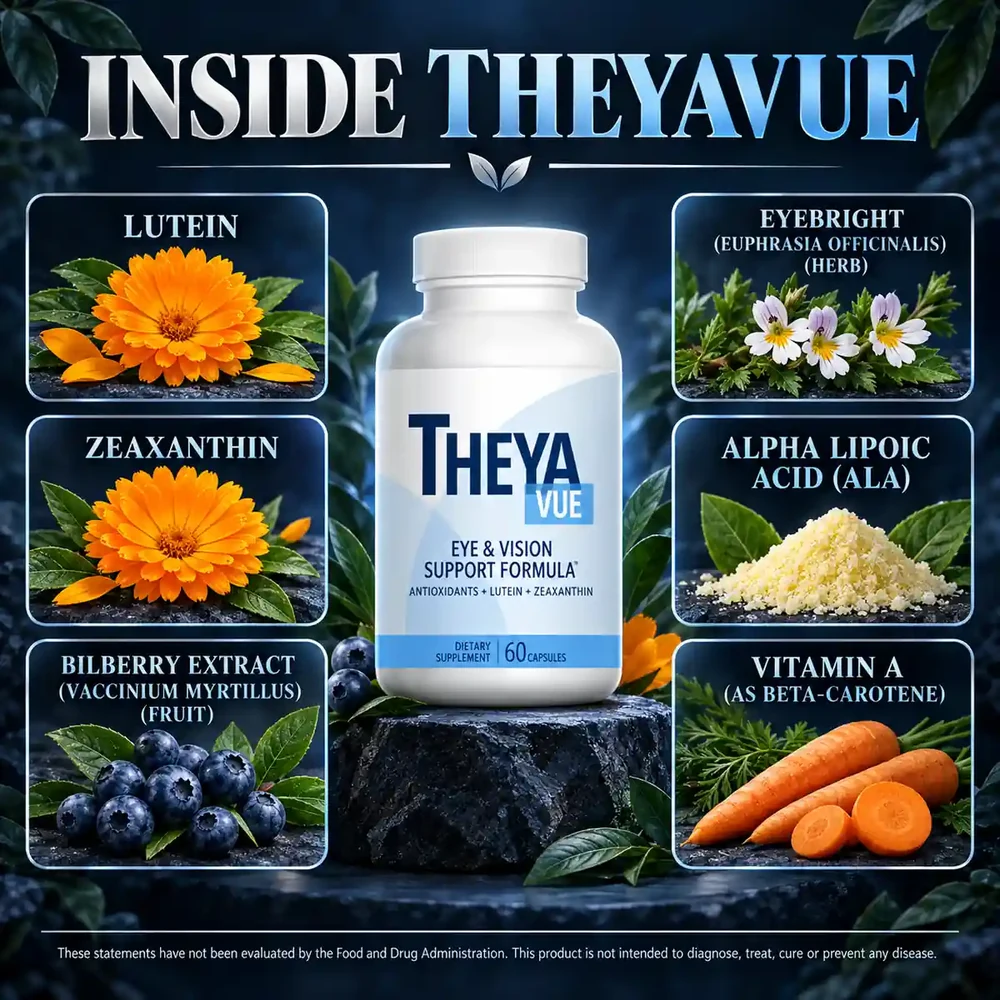
Count the panel. It declares fifteen vitamins and minerals individually, each with its own amount and %DV, and then a 240.5 mg proprietary blend holding ten more: lutein, bilberry, alpha lipoic acid, eyebright, zeaxanthin, quercetin, rutin, L-taurine, grape seed extract and lycopene. That is twenty-five named ingredients. The seller’s pack names six. The “Inside TheyaVue” card names six. The “How TheyaVue Works” card names five. Nineteen ingredients are on the bottle and in no piece of marketing we were given. All twenty-five are published here, in the panel’s own order.
What 240.5 mg does and does not tell you
240.5 mg is the whole blend, not any ingredient in it. Ten things share that number and the panel does not say how. A proprietary blend is allowed to declare one total on condition its members are listed in descending order by weight, so lutein is the largest share and lycopene the smallest — and that is the entire content of what you are told.
The descending-order rule gives you the sequence and nothing about the gaps. Lutein is the largest share and lycopene the smallest, but the largest share of 240.5 mg could be 200 mg or 30 mg and the label would read the same either way. On most supplements that is a cosmetic annoyance. On an eye supplement it removes the one figure the category is judged on.
The formula
Every TheyaVue ingredient, in the panel’s printed order
Sixteen dossiers: the blend’s ten, then the declared nutrients that matter most on an eye label.
The blend’s ten first, in their descending-order sequence, then the declared nutrients that carry the most weight on an eye label. Each dossier opens to the same four things: what it is, why it is here, the amount against whatever reference figure exists, and what that leaves you with. Where there is no federal page at all, it says so rather than filling the space.
Lutein
First in the blend, and the ingredient the whole category is built on.
not published (inside the 240.5 mg blend)
Lutein
First in the blend, and the ingredient the whole category is built on.
A carotenoid that concentrates in the macula, the small central part of the retina. It is the first-named member of this blend, which under the descending-order rule makes it the largest share of the 240.5 mg.
This is the one ingredient here with a specific federal number attached to it. The National Eye Institute’s AREDS2 formula used <strong>lutein 10 mg</strong>. Whether this capsule gets near that is unknowable, because the split of the blend is not published.
In TheyaVue: not published (inside the 240.5 mg blend) Reference: AREDS2 used 10 mg a day
If the entire blend were lutein it would clear 10 mg many times over. It is not: ten ingredients share the number.
Bilberry extract
Second in the blend, and the ingredient with the least flattering federal write-up in the bottle.
not published (inside the blend)
Bilberry extract
Second in the blend, and the ingredient with the least flattering federal write-up in the bottle.
NCCIH describes the bilberry bush as “native to northern areas in Europe, the northern United States, and Canada”, with “dark berries [that] resemble blueberries”. Extracts have “traditionally been used for conditions related to vision”.
It is the classic night-vision botanical, and NCCIH’s summary of the research is short: “Studies of the effects of bilberry on night vision have had conflicting results. Much of the research was of poor quality.” More broadly, “Bilberry has not been clearly shown to be helpful for any health condition.”
In TheyaVue: not published (inside the blend) Reference: No agreed research dose
The panel prints no standardisation for the extract, so even the anthocyanin content is unknown.
Alpha lipoic acid (ALA)
Third in the blend, and an antioxidant rather than an eye ingredient.
not published (inside the blend)
Alpha lipoic acid (ALA)
Third in the blend, and an antioxidant rather than an eye ingredient.
A compound the body makes in small amounts and that is sold as an antioxidant supplement. It appears in eye formulas on the general oxidative-stress argument rather than on a specific retinal one.
No federal consumer fact sheet covers alpha lipoic acid for vision, and AREDS2 did not include it. It is in this bottle because the category expects an antioxidant list, not because a trial put it there.
In TheyaVue: not published (inside the blend) Reference: No federal consumer page covers it for eye health
Third of ten in a 240.5 mg blend, so a minority share of a small total.
Eyebright
Fourth in the blend, and the ingredient whose name does the most work.
not published (inside the blend)
Eyebright
Fourth in the blend, and the ingredient whose name does the most work.
A small flowering herb whose common name is its entire marketing. It has a long history in traditional European use for eye complaints.
NCCIH’s Herbs at a Glance index does not cover eyebright, so there is no federal plain-language summary to point you at. That is an absence of a summary rather than evidence of harm — but on a label sold for vision, an ingredient named after eyes and backed by no federal page is worth flagging.
In TheyaVue: not published (inside the blend) Reference: No agreed research dose
Fourth of ten, unstandardised, inside 240.5 mg.
Zeaxanthin
Fifth in the blend — and the second half of the pair AREDS2 actually tested.
not published (inside the blend)
Zeaxanthin
Fifth in the blend — and the second half of the pair AREDS2 actually tested.
The other macular carotenoid. Lutein and zeaxanthin are always sold together because they are found together in the macula and were tested together.
AREDS2 used <strong>zeaxanthin 2 mg</strong> alongside 10 mg of lutein. Being fifth of ten in this blend rather than second tells you it is a smaller share than lutein, which is the right order — but the amount is still not published.
In TheyaVue: not published (inside the blend) Reference: AREDS2 used 2 mg a day
Fifth of ten by weight inside 240.5 mg.
Quercetin
Sixth in the blend, and the first of five ingredients that appear in no marketing image at all.
not published (inside the blend)
Quercetin
Sixth in the blend, and the first of five ingredients that appear in no marketing image at all.
A plant flavonoid, here sourced from the buds of the Japanese pagoda tree. It is sold broadly as an antioxidant and is not specific to eyes.
It is on the bottle and on none of the cards, which is the pattern for everything from here down the list.
In TheyaVue: not published (inside the blend) Reference: No federal consumer page covers it for eye health
Sixth of ten by weight.
Rutin
Seventh in the blend, from the same plant as the row above it.
not published (inside the blend)
Rutin
Seventh in the blend, from the same plant as the row above it.
Another flavonoid from the pagoda tree, this time from the flower. Rutin and quercetin are chemically related — rutin is a glycoside of quercetin.
Two closely related flavonoids from the same species, listed separately, both unquantified. It lengthens the ingredient list more than it changes what is in the capsule.
In TheyaVue: not published (inside the blend) Reference: No federal consumer page covers it for eye health
Seventh of ten by weight, so a small share of a small total.
L-Taurine
Eighth in the blend.
not published (inside the blend)
L-Taurine
Eighth in the blend.
An amino acid found in high concentrations in the retina. That is the reason it appears in eye formulas.
The retinal-concentration fact is real; a federal consumer summary of taurine supplements for vision is not something we could find.
In TheyaVue: not published (inside the blend) Reference: No federal consumer page covers it for eye health
Eighth of ten by weight.
Grape seed extract
Ninth in the blend.
not published (inside the blend)
Grape seed extract
Ninth in the blend.
An extract sold for its proanthocyanidin content, usually on a circulation and antioxidant argument.
No standardisation is printed, which for a polyphenol extract is the figure that would have told you anything.
In TheyaVue: not published (inside the blend) Reference: No agreed research dose for vision
Ninth of ten by weight.
Lycopene
Tenth and last in the blend, so the smallest share of the 240.5 mg.
not published (inside the blend)
Lycopene
Tenth and last in the blend, so the smallest share of the 240.5 mg.
The carotenoid that makes tomatoes red. It is an antioxidant and, unlike lutein and zeaxanthin, it does not concentrate in the macula.
Last place on a descending-order list inside a 240.5 mg total is a very small amount of anything. It is on the label as a name more than as a dose.
In TheyaVue: not published (inside the blend) Reference: No federal consumer page covers it for eye health
Tenth of ten by weight.
Vitamin A (as beta-carotene)
Declared separately from the blend — and the row to raise with a clinician if you smoke or used to.
50 mcg RAE a capsule (5% DV)
Vitamin A (as beta-carotene)
Declared separately from the blend — and the row to raise with a clinician if you smoke or used to.
ODS: “Vitamin A is important for normal vision.” It distinguishes preformed vitamin A from provitamin A carotenoids like beta-carotene, which the body converts. This label uses the carotenoid form.
Beta-carotene is the ingredient AREDS2 <em>removed</em>. ODS states that “smokers, former smokers, and people exposed to asbestos who take high-dose beta-carotene supplements have a higher risk of lung cancer and death”, and NEI reports the same finding from AREDS2 itself.
In TheyaVue: 50 mcg RAE a capsule (5% DV) Reference: RDA 900 mcg RAE for adult men, 700 for adult women
50 mcg RAE is 5% of a day’s value; 100 mcg at the directed two capsules. These are not the high doses in those studies.
Vitamin C
An AREDS2 ingredient, at a fifth of the AREDS2 amount.
100 mg a capsule (111% DV)
Vitamin C
An AREDS2 ingredient, at a fifth of the AREDS2 amount.
ODS: vitamin C “acts as an antioxidant, helping to protect cells from the damage caused by free radicals”, and the body needs it to make collagen.
AREDS2 used <strong>500 mg</strong>. This capsule has 100 mg, or 200 mg at the directed two — more than the 90 mg adult RDA, and well under the trial.
In TheyaVue: 100 mg a capsule (111% DV) Reference: AREDS2 used 500 mg a day; RDA 90 mg (men), 75 mg (women)
200 mg a day at the directed dose. The upper limit is 2,000 mg.
Vitamin E
An AREDS2 ingredient, in the synthetic form, at a small fraction of the trial amount.
10 mg a capsule (66% DV)
Vitamin E
An AREDS2 ingredient, in the synthetic form, at a small fraction of the trial amount.
ODS describes vitamin E as an antioxidant that helps protect cells. It also distinguishes the forms: natural vitamin E is d-alpha-tocopherol, synthetic is <strong>dl</strong>-alpha-tocopherol — and “1 mg vitamin E = 1 mg d-alpha-tocopherol (natural vitamin E) = 2 mg dl-alpha-tocopherol (synthetic vitamin E)”.
This panel prints DL-alpha tocopherol acetate: the synthetic form, the less potent of the two by weight. AREDS2 used 400 IU, which is many times the 15 mg adult RDA however you convert it.
In TheyaVue: 10 mg a capsule (66% DV) Reference: AREDS2 used 400 IU a day; RDA 15 mg
20 mg a day at the directed two capsules.
Zinc
The row that gets closest to a federal ceiling at the directed dose.
16 mg a capsule (145% DV)
Zinc
The row that gets closest to a federal ceiling at the directed dose.
ODS: the body uses zinc to make DNA and proteins, and it supports immune function and wound healing. The RDA is 11 mg for adult men and 8 mg for adult women.
Zinc is the backbone of the AREDS formula — the trial used <strong>80 mg</strong>. This capsule has 16 mg, which is 32 mg at the directed two: under the trial, and at 80% of the adult upper limit.
In TheyaVue: 16 mg a capsule (145% DV) Reference: AREDS2 used 80 mg a day; RDA 11 mg (men), 8 mg (women)
32 mg a day at the directed dose, against a 40 mg upper limit that counts food and every other supplement too.
Vitamin B3 (niacin)
The row that crosses a federal ceiling at the directed dose.
20 mg NE a capsule (125% DV)
Vitamin B3 (niacin)
The row that crosses a federal ceiling at the directed dose.
ODS: “Niacin (also called vitamin B3) helps turn the food you eat into the energy you need.” The RDA is 16 mg NE for adult men and 14 mg NE for adult women.
At one capsule this is 125% of a day’s value and unremarkable. At the directed two it is <strong>40 mg NE, above the 35 mg adult upper limit</strong> ODS publishes. That is not a dangerous amount, but it is over a published line and the label never mentions it.
In TheyaVue: 20 mg NE a capsule (125% DV) Reference: RDA 14-16 mg NE; upper limit 35 mg
40 mg NE a day at the directed dose.
Copper
The one row that matches AREDS2 exactly at the directed dose.
1 mg a capsule (111% DV)
Copper
The one row that matches AREDS2 exactly at the directed dose.
A trace mineral. In eye formulas it is present for a specific reason: high-dose zinc interferes with copper absorption, so AREDS added copper to go with it.
AREDS2 used <strong>copper 2 mg</strong>. This capsule has 1 mg, so <strong>2 mg at the directed two capsules</strong> — the only row in the whole comparison that lands on the trial figure.
In TheyaVue: 1 mg a capsule (111% DV) Reference: AREDS2 used 2 mg a day
2 mg a day at the directed dose.
Turn the cards
The ten inside the 240.5 mg blend
Front: what it is. Back: what the federal page says about it.
Ten ingredients, one number, no split
The front of each card is what the ingredient is. Turn it over and you get what a federal page actually found, quoted rather than paraphrased. Four of the ten have a federal sentence behind them; the other six have an absence, which is not the same as a negative finding and not the same as evidence either.
Tap or hover a card to turn it over.
Read those ten backs in a row and a pattern appears that no marketing card shows you. The two ingredients with real federal numbers attached are the two whose amounts are missing. The two with the most quotable federal sentences behind them are quotable mostly for what the sentence says is not there. None of that is an accusation: a proprietary blend is a lawful way to write a label and nothing here is undeclared. It is simply the shape of what you are being sold.
The panel
All twenty-five rows, with the directed dose alongside
| As the panel prints it | Per capsule | %DV | At two capsules a day |
|---|---|---|---|
| Vitamin A (as Beta-carotene) | 50 mcg RAE | 5% | 100 mcg RAE |
| Vitamin C (as Ascorbic Acid) | 100 mg | 111% | 200 mg |
| Calcium (as Calcium carbonate) | 25 mg | 2% | 50 mg |
| Vitamin E (DL-Alpha tocopherol acetate) | 10 mg | 66% | 20 mg |
| Vitamin B1 (as Thiamine mononitrate) | 4 mg | 333% | 8 mg |
| Vitamin B2 (as Riboflavin) | 4 mg | 307% | 8 mg |
| Vitamin B3 (as Niacin) | 20 mg NE | 125% | 40 mg NE |
| Vitamin B12 (as Cyanocobalamin) | 13.5 mcg | 562% | 27 mcg |
| Biotin | 400 mcg | 1,333% | 800 mcg |
| Magnesium (as Magnesium oxide) | 20 mg | 5% | 40 mg |
| Zinc (as Zinc oxide) | 16 mg | 145% | 32 mg |
| Selenium (as Selenium AAC) | 4 ug | 7% | 8 ug |
| Copper (as Copper gluconate) | 1 mg | 111% | 2 mg |
| Chromium (as Chromium picolinate) | 1.8 mcg | 5% | 3.6 mcg |
| Proprietary Blend (10 ingredients) | 240.5 mg | * | 481 mg |
| — Lutein | not published | — | not published |
| — Bilberry Extract (Vaccinium myrtillus) (fruit) | not published | — | not published |
| — Alpha Lipoic Acid (ALA) | not published | — | not published |
| — Eyebright (Euphrasia officinalis) (herb) | not published | — | not published |
| — Zeaxanthin | not published | — | not published |
| — Quercetin (Sophora japonica) (bud) | not published | — | not published |
| — Rutin (Sophora japonica L.) (flower) | not published | — | not published |
| — L-Taurine | not published | — | not published |
| — Grape Seed Extract (Vitis vinifera L.) (seed) | not published | — | not published |
| — Lycopene | not published | — | not published |
The %DV column is the panel’s own, and it describes one capsule. The right-hand column is our arithmetic on the panel’s numbers, doubled, because the directions ask for two.
Two rows in that last column are set in bold and they are the reason the table has a last column at all. Niacin becomes 40 mg NE against an adult upper limit of 35 mg, and zinc becomes 32 mg against a 40 mg limit that counts every other source. Neither comes from misusing the product; both come from following the directions printed on it, and no note on the label reconciles a one-capsule panel with a two-capsule instruction.
Where these numbers come from
Every figure above is read off the Supplement Facts panel supplied in the product artwork. The other-ingredients line reads: Cellulose (Vegetable Capsule), Rice Flour, Magnesium Stearate, Silicon Dioxide. Four other ingredients, and the first of them settles a question this category usually leaves open: the shell is cellulose, a vegetable capsule, not gelatin. The vegetarian roundel on this packaging is supported by the label’s own words, which is not something we have often been able to write.
The honest section
The ingredients that appear in no marketing image
Named here because this is the only place they are named.
Vitamin A as beta-carotene, lutein, zeaxanthin, bilberry, eyebright and alpha lipoic acid are the six that appear on the marketing cards. Everything else on this bottle is on the bottle only.
The five blend members with no picture anywhere
Quercetin, rutin, L-taurine, grape seed extract and lycopene sit sixth to tenth in the descending-order list, which is the part of a blend where amounts get small. None appears in a marketing image, none has a published amount, and none has a federal consumer page for eye health. Two of the five come from the same plant, Sophora japonica, one from the bud and one from the flower. Listing them separately is accurate and also flattering: it turns one plant into two lines on a label.
And the declared nutrients that never make the artwork
Vitamin C, calcium, vitamin E, thiamine, riboflavin, niacin, B12, biotin, magnesium, zinc, selenium, copper and chromium are each declared with an amount and a %DV, and none is the subject of a marketing image. Pictures go to botanicals because botanicals photograph well, which produces an odd result here: the rows with the clearest numbers, the ones you could check against a federal fact sheet, are the rows nobody is selling you. Zinc and copper are AREDS2 ingredients at readable amounts. Niacin crosses a published ceiling at the directed dose. Not one of them is in a photograph.
What we would ask the sales desk
Three questions, in order of usefulness. How many milligrams of lutein and zeaxanthin are in one capsule. What the bilberry, grape seed and eyebright extracts are standardised to, if anything. And whether the panel’s one-capsule serving or the twice-daily direction is the one the formula was designed around. The sales line is +1 (315) 724-2018.
Questions
TheyaVue FAQ: ingredients questions
What is actually in a TheyaVue capsule?
Twenty-five named things. Fifteen with their own amounts: vitamin A as beta-carotene, vitamin C, calcium, vitamin E, B1, B2, B3, B12, biotin, magnesium, zinc, selenium, copper and chromium. Then a 240.5 mg blend of lutein, bilberry, alpha lipoic acid, eyebright, zeaxanthin, quercetin, rutin, L-taurine, grape seed extract and lycopene.
How much lutein is in it?
Not published. Lutein is the first-named member of the 240.5 mg proprietary blend, and a blend may declare one total on condition its members run in descending order by weight. So lutein is the largest of ten shares of 240.5 mg — and that is everything the label tells you. AREDS2 used 10 mg.
Why does the marketing name six ingredients?
The seller’s pack, the “Inside TheyaVue” card and the “How TheyaVue Works” card all name five or six: lutein, zeaxanthin, bilberry, eyebright, alpha lipoic acid and vitamin A. The panel names twenty-five. The panel is the regulated document, so all twenty-five are published here.
Does it help with night vision?
Bilberry is the ingredient that claim usually rests on. NCCIH: “Studies of the effects of bilberry on night vision have had conflicting results. Much of the research was of poor quality.” More broadly, “Bilberry has not been clearly shown to be helpful for any health condition.”
Is it vegetarian?
Yes, on the label’s own evidence. The other-ingredients line reads “Cellulose (Vegetable Capsule), Rice Flour, Magnesium Stearate, Silicon Dioxide” and nothing on the panel is animal-derived. The capsule shell is where a vegetarian claim usually fails on a capsule product; here it holds.
Where do your ingredient facts come from?
The amounts come from the Supplement Facts panel supplied in the product artwork. The context around them comes from the National Eye Institute, the NIH Office of Dietary Supplements, NCCIH and the FDA. Every page lists its sources with links.
References
Sources for this page
- National Eye Institute, NIH. About the Age-Related Eye Disease Studies (AREDS and AREDS2). www.nei.nih.gov. Accessed September 23, 2026.
- National Center for Complementary and Integrative Health. Bilberry. www.nccih.nih.gov. Accessed September 23, 2026.
- NIH Office of Dietary Supplements. Vitamin A and Carotenoids. ods.od.nih.gov. Accessed September 23, 2026.
- NIH Office of Dietary Supplements. Zinc. ods.od.nih.gov. Accessed September 23, 2026.
- NIH Office of Dietary Supplements. Niacin. ods.od.nih.gov. Accessed September 23, 2026.
Next
Keep reading
The panel, row by row
Every figure, the two printing slips, and what the label never says.
Read it →The mechanism, and AREDS2
What the trial tested, in whom, and what NEI reports it did not do.
Read it →Niacin, zinc and beta-carotene
No warnings panel was supplied, so the federal pages stand in.
Read it →Order TheyaVue from the official page
60 capsules a bottle in a vegetable capsule shell, twenty-five named ingredients, and 60 days from purchase to change your mind. Price is shown at checkout. Sales line +1 (315) 724-2018.
Price shown at checkout · 60-day window from purchase · ships from inside the US · sales line +1 (315) 724-2018