TheyaVue blog
When a Blend Hides the One Number That Matters
Ten ingredients, one total, and the two you came for sitting somewhere inside it.
On this page
- Two ways to fill in a panel
- What a proprietary blend legally is
- Descending order by weight, and what it rules out
- Why it bites hardest on an eye supplement
- This label, read in two halves
- The arithmetic you cannot do
- Better than most on fifteen rows, worse than most on one
- What the blend does and does not tell you
Start here
Two ways to fill in a panel
There are two ways to fill in a Supplement Facts panel, and the choice between them is the most informative decision a manufacturer makes about a label. The first is to declare every ingredient with its own amount beside it. The second is to gather several under a heading the company invented, print one total weight, and list the names without individual figures. That is a proprietary blend, and it is entirely legal.
Both panels look similar at arm’s length and both can sit on an honest product. The difference appears when you hold a number against a research figure, or against the same ingredient in a rival bottle. One panel lets you; the other stops you at the first step.
TheyaVue is the worked example, and an unusually clean one, because this label does both things at once. Its first fifteen rows are better disclosure than most of the category manages. Its sixteenth row hides the only figure the category is judged on.
The legal definition
What a proprietary blend legally is
A proprietary blend is a group of dietary ingredients declared together under a name the manufacturer chose, with one total weight and no individual amounts for its members.
What it is not
It is not a loophole, and not on its own a sign of a bad product. The provision exists so a company can develop a formula without publishing a recipe a competitor could copy off the shelf — a real commercial concern rather than an excuse.
What it still has to do
Name every dietary ingredient in the blend, print the total weight of the group, and list the names in descending order by weight. The other-ingredients line underneath, carrying the capsule shell and any fillers, sits outside the blend entirely.
Everything else may be left out: no amount per ingredient, no percentage, no ratio, no range, no indication of how uneven the split is. The total is a true number about the group that tells you nothing about any member of it.
The one usable fact
Descending order by weight, and what it rules out
The ordering rule is the one usable fact a blend gives you, so be precise about it. The first name weighs more than the second, the second more than the third: a complete ranking with no quantities attached.
What that rules out
One specific kind of misdirection. The ingredient the marketing is built around cannot be quietly parked at the bottom of the list without that being visible. If the front of the box sells you one substance and that substance is listed last, the label has told you something useful and unflattering.
What it cannot tell you
Anything about the gaps between the names. Take a blend of ten ingredients totalling 240 milligrams. The first name might be 200 of those milligrams, or 30, and the printed order reads identically either way. The ranking narrows the possibilities without picking one, and on a ten-way split it barely narrows them at all. Treat descending order as the floor of what a label owes you rather than the standard.
The category problem
Why it bites hardest on an eye supplement
On a lot of products a blend costs you little, because there is no external figure to compare against anyway. Nobody has established the right amount of eyebright, and hiding a number that means nothing outside the bottle hides nothing.
Eye supplements are the exception
This category is different, and that is the whole point of this post. The two ingredients on the front of nearly every eye supplement — lutein and zeaxanthin — are among the very few supplement ingredients with a federal evidence base carrying published amounts. The National Eye Institute’s AREDS2 formulation lists lutein 10 mg and zeaxanthin 2 mg a day. Those figures are the reason this category can be checked at all.
Which makes the hidden number the only one that mattered
If a label declares lutein and zeaxanthin individually, a buyer can do the arithmetic in five seconds and reach a conclusion the seller cannot argue with. If both sit inside a blend, that comparison becomes impossible, and the marketing keeps every benefit of standing next to the trial while giving up nothing checkable. The blend is not hiding an unknowable. It is hiding the one number in the category that is knowable and published.
The worked example
This label, read in two halves
The first fifteen rows: better than most
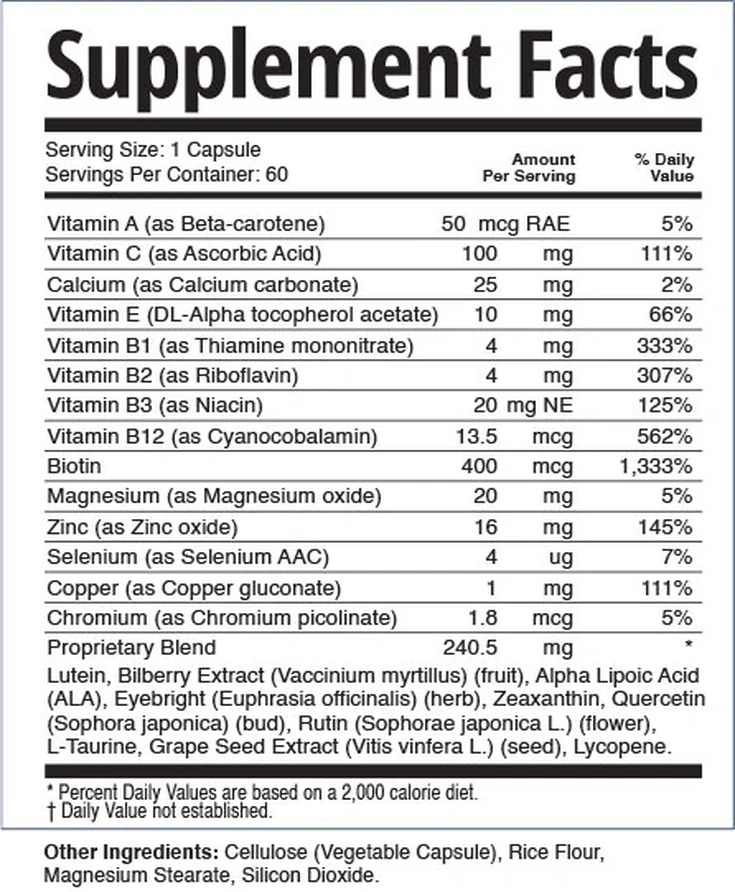
Fifteen vitamins and minerals are declared individually, each with its own amount and its own %DV. Vitamin C 100 mg. Vitamin E 10 mg. Zinc 16 mg. Copper 1 mg. Every one can be looked up, doubled to the directed dose and held against a federal fact sheet by anybody with a phone. That is above the standard of this category, and it should be said first.
The sixteenth row: worse than most
240.5 mg shared by ten: lutein, bilberry extract, alpha lipoic acid, eyebright, zeaxanthin, quercetin, rutin, L-taurine, grape seed extract and lycopene. 240.5 mg is the whole blend, not any ingredient in it. Ten things share that number and the panel does not say how. A proprietary blend is allowed to declare one total on condition its members are listed in descending order by weight, so lutein is the largest share and lycopene the smallest — and that is the entire content of what you are told.
Read the order carefully, because it is all you get. Lutein is first, so it is the largest share of that 240.5 mg. Zeaxanthin is fifth. Lycopene is last. That is the whole of what the label says about the two ingredients on the front of the bottle.
Where it stops
The arithmetic you cannot do
Here is the arithmetic a buyer would want, and where it stops.
The comparison that is available
The directions ask for two capsules a day, so every declared figure doubles. Copper reaches 2 mg, exactly what AREDS2 used. Vitamin C reaches 200 mg against the trial’s 500 mg. Zinc reaches 32 mg against 80 mg. Three clean comparisons, drawn in under a minute, which is what a declared amount is for.
The comparison that is not
Lutein against 10 mg, and zeaxanthin against 2 mg. Both are unavailable, and no care on the reader’s part recovers them. If the entire 240.5 mg were lutein it would clear the trial figure many times over, but it is not, and the panel does not say what fraction it is. The lower bound is equally useless, because descending order permits a very small amount as easily as a large one.
What that means for the front of the bottle
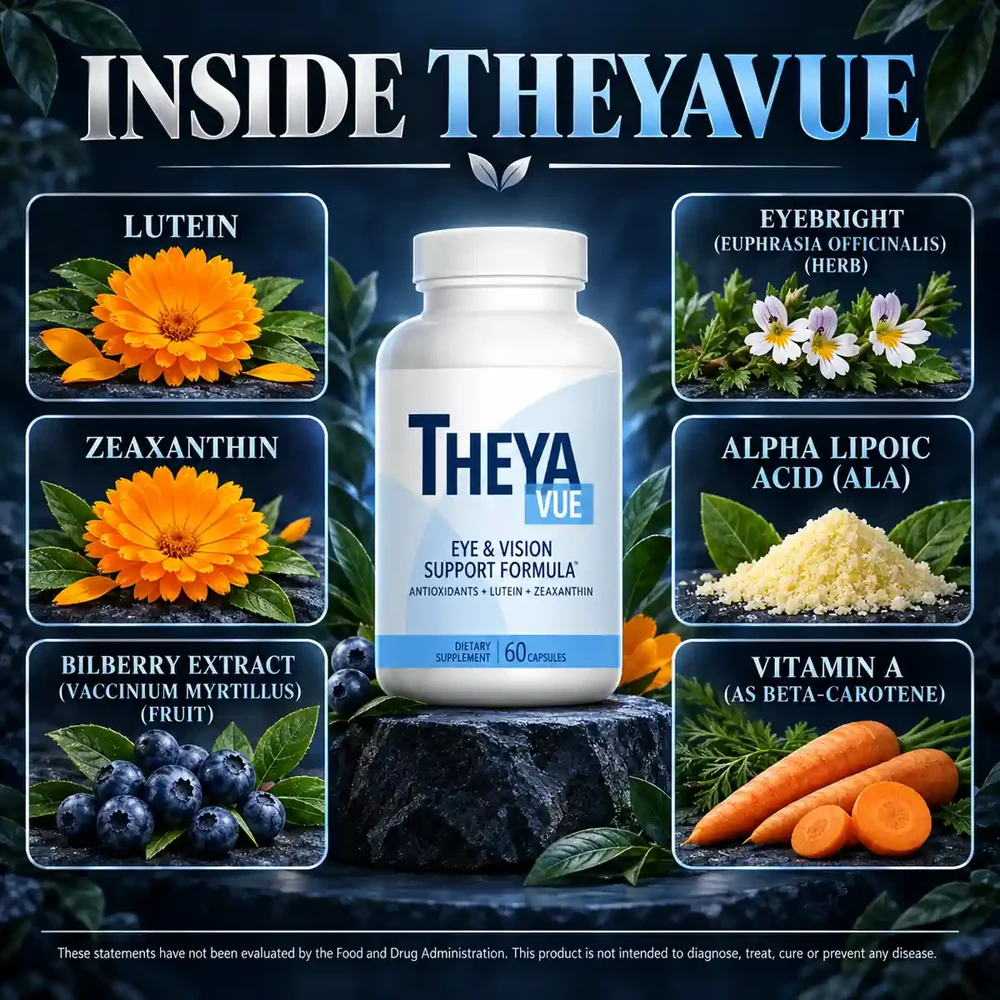
Count the panel. It declares fifteen vitamins and minerals individually, each with its own amount and %DV, and then a 240.5 mg proprietary blend holding ten more: lutein, bilberry, alpha lipoic acid, eyebright, zeaxanthin, quercetin, rutin, L-taurine, grape seed extract and lycopene. That is twenty-five named ingredients. The seller’s pack names six. The “Inside TheyaVue” card names six. The “How TheyaVue Works” card names five. Nineteen ingredients are on the bottle and in no piece of marketing we were given. All twenty-five are published here, in the panel’s own order.
Eight of the ten blend members have no agreed research dose, so hiding their amounts costs a buyer little. The two exceptions are the two on the front panel.
Both facts, one decision
Better than most on fifteen rows, worse than most on one
The conclusion, plainly. On its first fifteen rows this label is better than most things in the category: individual amounts, individual percentages, a complete other-ingredients line and directions that specify timing, food and water. On the one row where the category is actually judged, it is worse than most. Lutein and zeaxanthin are why anybody picks up an eye supplement, AREDS2 gives both a published figure, and this panel answers with a shared total and a ranking.
Why both facts are true at once
Fifteen nutrients were declared because declaring them is easy and flattering — several of those %DV figures are well over a hundred per cent and look generous on a panel. The ten that were not declared are the ones where a number would have invited a comparison the product may not win. We cannot say that is why it was done, and will not pretend otherwise. What we can say is that the incentive runs that way, and that a buyer holding this panel gets credit-worthy disclosure everywhere except the place they came for.
Closing
What the blend does and does not tell you
A blend is not evidence of a weak formula. It is evidence of nothing at all, which is the problem: it turns a checkable question into an unanswerable one, and silence gets read as neutral more often than it deserves. Reward the disclosure where you find it, judge the numbers you are given, and treat the missing ones as missing rather than as fine.
The honest version
We would rather praise this panel for its fifteen declared rows and still say the sixteenth costs it the comparison that counts. If lutein and zeaxanthin amounts are what you are shopping on, this label does not give them to you. The supplement facts page prints every line, the ingredients page works through all twenty-five, and if your eyesight has changed, the National Eye Institute is clear that a dilated eye exam is the only way to catch many eye diseases early.
References
Sources
- National Eye Institute, NIH. About the Age-Related Eye Disease Studies (AREDS and AREDS2). www.nei.nih.gov. Accessed September 23, 2026.
- National Center for Complementary and Integrative Health. Bilberry. www.nccih.nih.gov. Accessed September 23, 2026.
- National Center for Complementary and Integrative Health. Using Dietary Supplements Wisely. www.nccih.nih.gov. Accessed September 23, 2026.
- NIH Office of Dietary Supplements. Dietary Supplements: What You Need to Know. ods.od.nih.gov. Accessed September 23, 2026.
- U.S. Food and Drug Administration. Information for Consumers on Using Dietary Supplements. www.fda.gov. Accessed September 23, 2026.
Order TheyaVue from the official page
Vegetable capsules, 60 capsules a bottle, two a day before meals, so thirty days a bottle. Twenty-five ingredients on the panel and a 240.5 mg blend whose split is not published. Prices and the 60-day window are on the listing; sales line +1 (315) 724-2018.
Price shown at checkout · 60-day window from purchase · ships from inside the US · sales line +1 (315) 724-2018
Next
Keep reading
The whole published panel
Every printed line, and the things this label does not publish at all.
Read it →All twenty-five, one at a time
What each ingredient is, and what the federal page for it says.
Read it →The trial the numbers come from
What AREDS2 tested, in whom, and the two findings buyers rarely see.
Read it →